atheryon / labs / system

Atheryon Labs. The banking platform built by AI.

Atheryon Labs is a marketplace-bound CDM-native banking platform — a working reference today, packaged for cloud marketplace distribution as it matures. Built by one capital-markets expert directing AI, it demonstrates how complex financial data can be modelled, linked, structured, and turned into usable banking software that institutions can license, deploy, and extend.

§01 / Why Credible

Atheryon is the integration partner for S&P TeraHelix.

Atheryon works in the same problem space that serious financial institutions are now prioritising: data modelling, linking, interoperability, and AI-ready enterprise data.

S&P Global completed its acquisition of TeraHelix in June 2025 to strengthen advanced data modelling and linking capabilities. S&P described TeraHelix as helping solve complex enterprise-scale data challenges by structuring data models for interoperability across platforms, systems, and storage architectures.

Atheryon Labs applies that same class of thinking to banking software: CDM-native data structures, expert-directed prompts, AI-assisted engineering, and practical platform surfaces across trading, operations, risk, treasury, compliance, and mortgages.

The result: a working banking AI platform you can inspect, license, or learn how to build.

§02 / Offers

Code, prompts, advisory

  1. 01
    Take the code.

    The reference implementation as a case study or co-marketed proof point.

    Jump to detail ↓
  2. 02
    Take the prompts.

    The directorial archive — packaged as a method asset for your tooling or vertical playbook.

    Jump to detail ↓
  3. 03
    Take the advisory.

    Architecture and delivery advisory for AI labs operating in regulated finance.

    Jump to detail ↓
§03 / Evidence

What was built, how fast

  1. 8
    banking functions covered
  2. 1
    CDM data model — compliant with ISDA (International Swaps and Derivatives Association), end to end
  3. 31
    flagship surfaces shipped
  4. Live
    at atheryon.com.au
  5. Weeks
    vs. multi-year consultancy programmes
Coverage
  • Operational Data Store
  • Front Office
  • Operations
  • Compliance & Reporting
  • Market Risk
  • Credit Risk
  • Treasury
  • Mortgages

The bank as Terry has worked it. Each function maps to a domain shipped inside a tier-1 institution.

Ecosystem
Microsoft PartnerS&P Global PartnerPowered by Claude (Anthropic)

Already inside the AI and financial-data ecosystem AI labs care about.

§04 / Flagships

What the platform actually does

Flagship 01

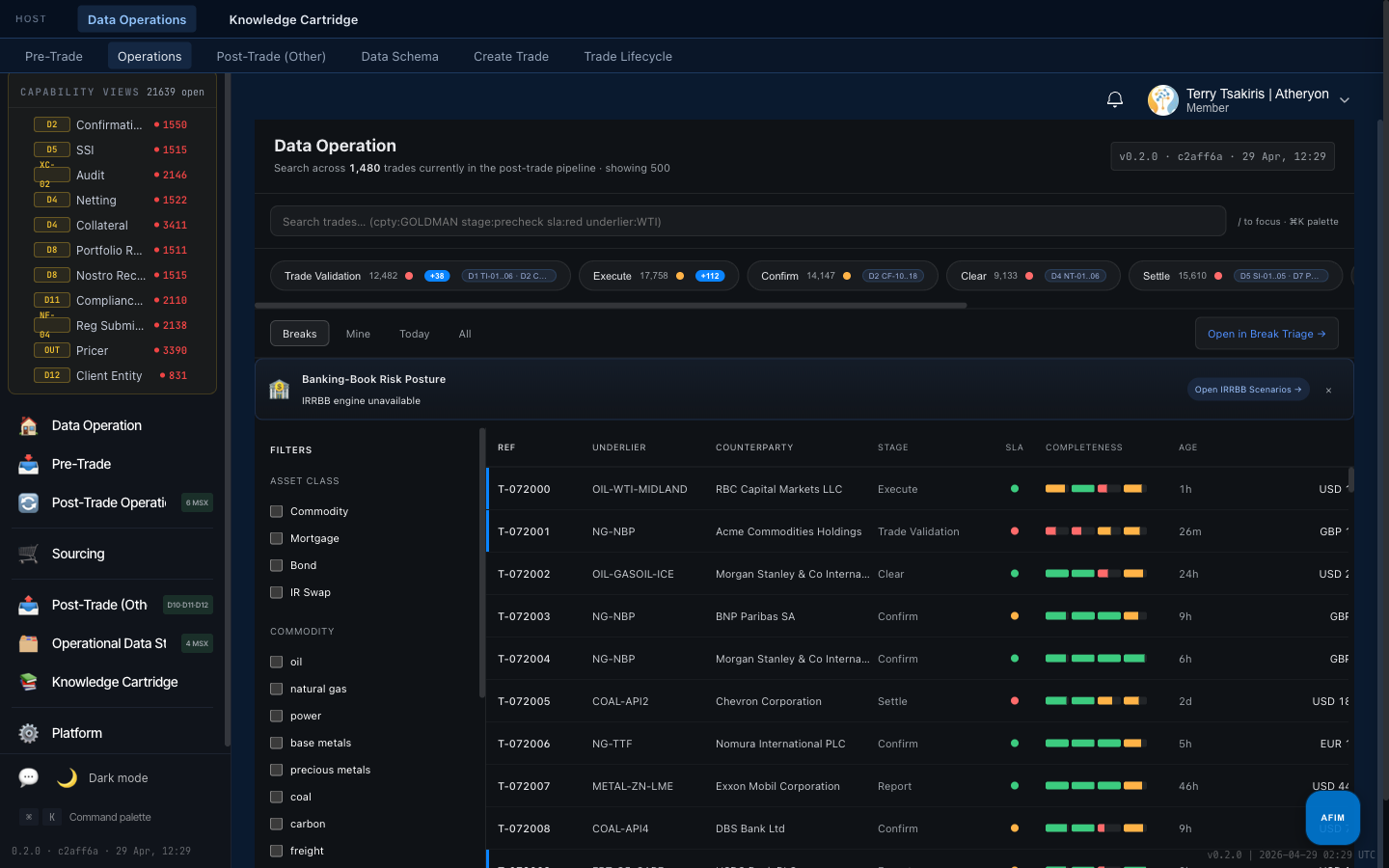
Trade Board + Operations

Problem

Operations teams in capital markets reconcile breaks, manage confirmations, and process lifecycle events end-of-day under hard regulatory deadlines. Most platforms model this as a workflow tool. The result is reconciliation that misses the underlying CDM event.

How it works

The /ops board is built directly on the CDM event model: every break, confirmation, and lifecycle action is an event with a typed payload. Operators triage breaks, run lifecycle actions, and the audit trail is the event stream itself — not an after-the-fact log.

CV anchor

CV anchor: CBA Markets ODS — Reg Trade Reporting, MiFID II, Surveillance.
Built in {{WEEKS}} weeks · {{PRS}} PRs · vs. typical multi-year programmes for an equivalent scope.

Atheryon Labs trade board and operations surface
Flagship 02

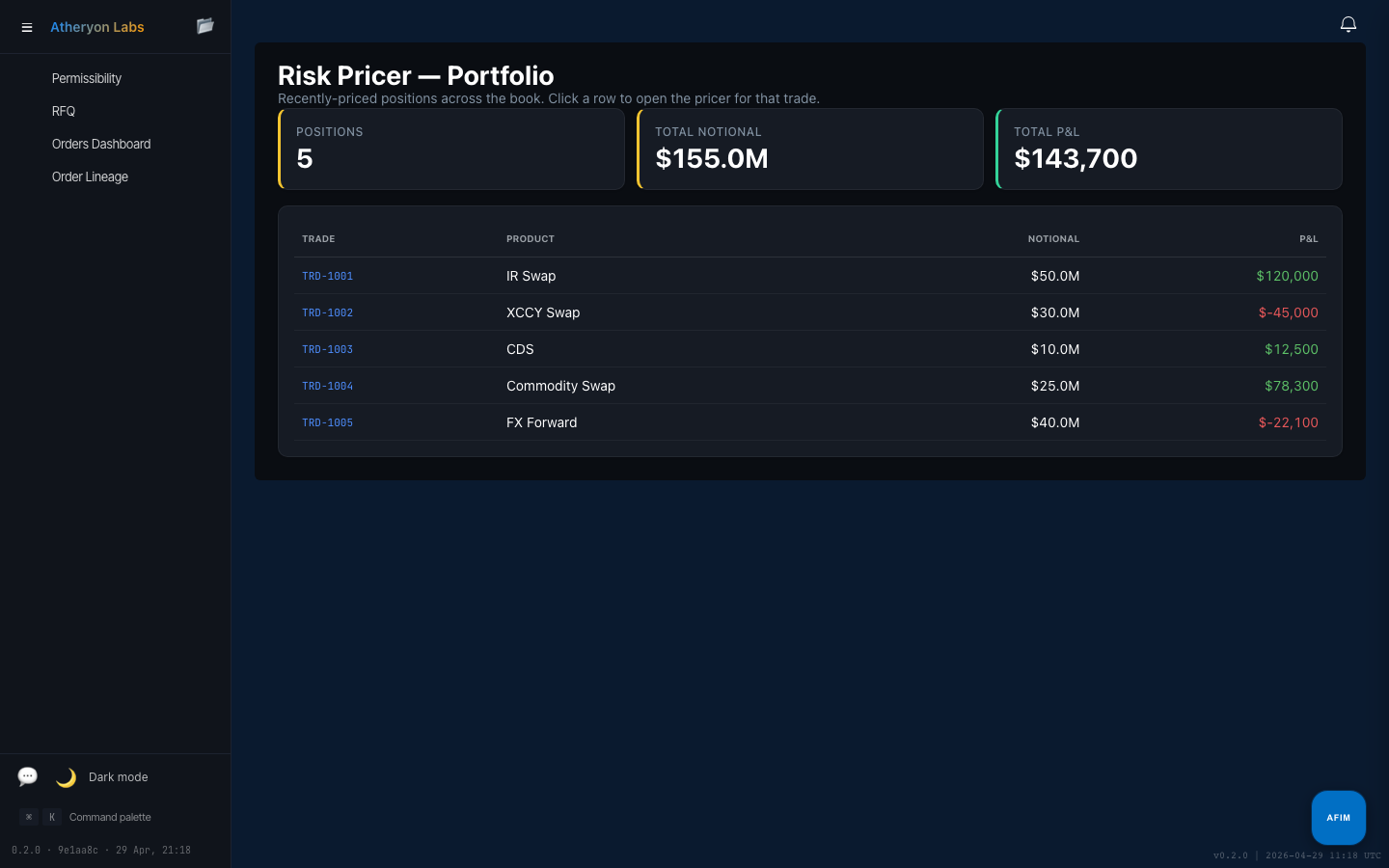
Risk Pricer + IRRBB

Problem

Front-office and middle-office risk teams need pricing and risk views that are fast, correct, and inspectable. Most platforms separate the pricer from the risk view, then reconcile them downstream. The reconciliation is where errors live.

How it works

/risk/pricer and /risk/irrbb call a typed atheryon-risk client over a shared CDM trade payload. Pricing and Greeks come from the same source; IRRBB views layer balance-sheet sensitivity on top. One model, one wire format, one source of truth for explain.

CV anchor

CV anchor: Credit Suisse FOBO risk + Global P&L Attribution.

Built in {{WEEKS}} weeks · {{PRS}} PRs · vs. typical multi-year programmes for an equivalent scope.

Atheryon Labs risk pricer and IRRBB surface
Flagship 03

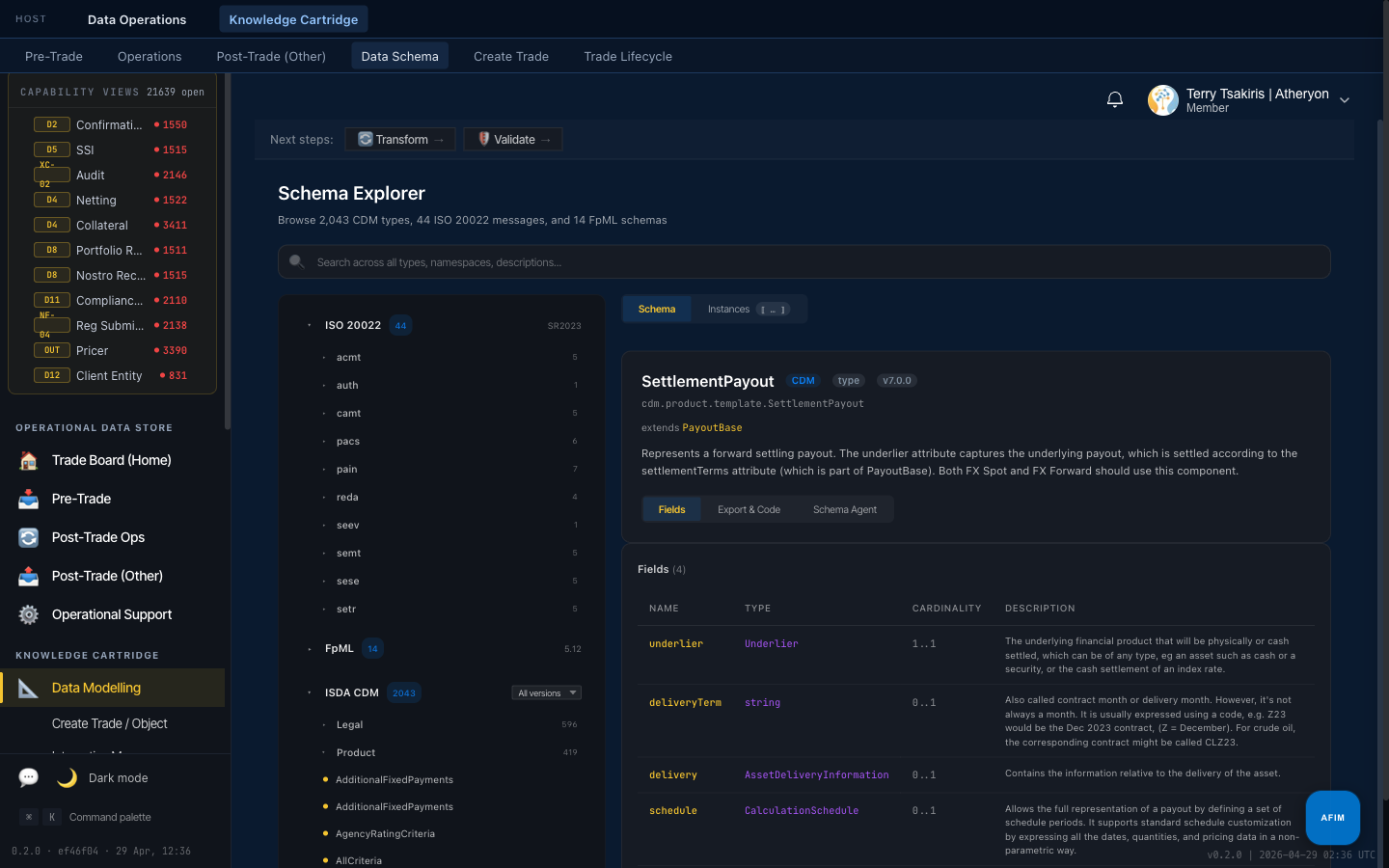
Schema Editor + CDM Intelligence

Problem

The hardest part of any banking data platform is keeping the data model honest under change. Most platforms treat the schema as a database concern. The result is silent drift between the model the business agrees to and the model the system enforces.

How it works

/build/schema-editor edits CDM types directly. /explore/graph walks instances of those types. Reg Submissions reverse-map regulator artefacts back to CDM, so the schema and the regulator are always in the same conversation.

CV anchor

CV anchor: the data-modelling thesis — the Atheryon differentiator.

Built in {{WEEKS}} weeks · {{PRS}} PRs · vs. typical multi-year programmes for an equivalent scope.

Vignette

Schema modelling — extend vs wrap

AI proposedThe AI defaulted to extending CDM types whenever a bank-specific field was needed. Inheritance, by the textbook.

Banker correctedColleagues who built Goldman SecDB taught the opposite: extend when the concept is genuinely a CDM concept with one more attribute; wrap when the concept is a bank-internal artefact that happens to reference CDM. The schema editor encodes both modes, and the rule for choosing.

Atheryon Labs schema editor and CDM intelligence surfaces
§05 / Banker × AI

AI in regulated finance needs the rare expert in the loop

AI labs competing with the global SIs in regulated verticals hit the same wall: plausible models, missing domain judgement. Atheryon Labs is the working artefact of an ontology-driven banking platform — semantics, lineage, validation, and access control modelled in from day one, then handed to AI as the operating ground. The two corrections below show why that loop matters.

Terry Tsakiris

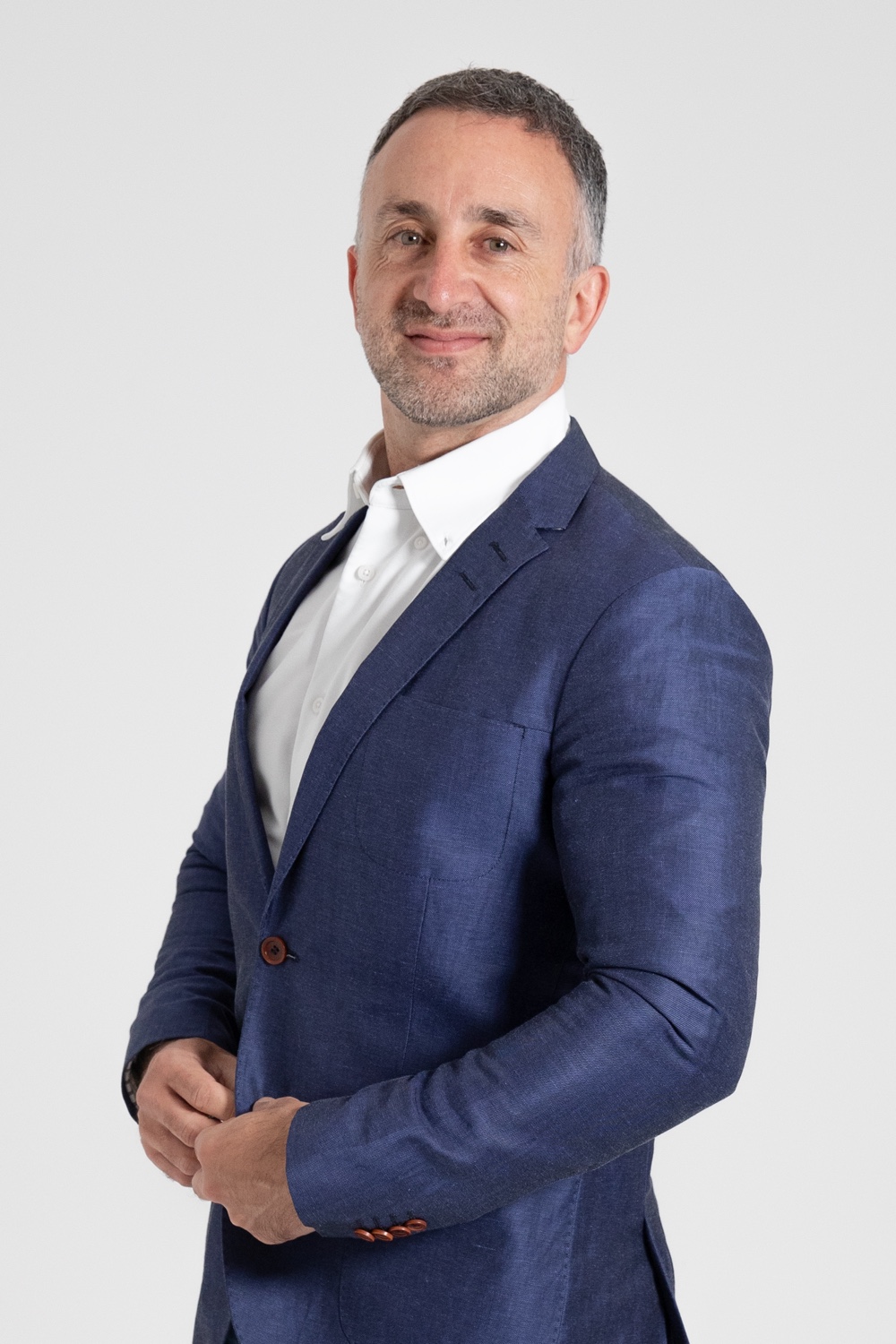
I’m Terry Tsakiris. At Credit Suisse I built the bank’s first near-real-time front-office risk system, then a global P&L Attribution platform across Fixed Income, Equities, FX and Rates. At Commonwealth Bank I owned the Markets Operational Data Store powering Regulatory Trade Reporting, MiFID II, and Trade Surveillance. At Westpac Institutional Banking I rescued a distressed $84M data programme and stood up a Data Products capability that delivered ten times faster than the bank’s prior baseline — the same compression AI labs need to compete with the consultancies that defended that baseline. Atheryon is a Microsoft partner and S&P Global partner; the platform is the next iteration of that method, paired with AI.

  1. Vignette 01

    Lifecycle state model

    AI proposedThe AI proposed modelling a trade as a row that moves through statuses — pending, confirmed, settled, terminated. Standard CRUD with a lifecycle column.

    Banker correctedCDM events are not trade states. Operations does not reconcile rows; it reconciles events — partial terminations, increases, novations, exercise — each one a typed payload with its own controls. The data model was rebuilt event-first, with the trade as a projection.

  2. Vignette 02

    Regulatory Trade Reporting evidence

    AI proposedThe AI generated reporting endpoints that emitted the regulator-required fields. Functionally complete by the spec.

    Banker correctedMiFID II and EMIR audits do not ask for the report; they ask for the *evidence chain* — what was reported, what changed, who approved, when. The platform was extended to emit a per-submission evidence artefact alongside the report. Reg Submissions is built around that artefact.

§06 / Method

How a banker directs AI

  • Principle 01

    Built from banking controls, not user stories.

    Where most AI demos start “as a user I want…”, this started with the regulatory artefact, the operational control, the risk view. Controls drive surfaces; surfaces do not drive controls.

  • Principle 02

    Started from the product / event / data model, not the screen.

    CDM-first, then surfaces. The data model is the contract. Every screen is a projection of it.

  • Principle 03

    Generate variants, then narrow them.

    Three implementation candidates per surface. AI generates them in minutes. Banking judgement rejects, corrects, and chooses.

  • Principle 04

    Every surface traceable to a banking function, CDM concept, and operating control.

    The labs IA enforces this. If a surface cannot be mapped, it does not ship.

  • Principle 05

    The deliverable is a working decision surface, not a slide deck.

    Inspectable, deployable, extendable. A reader who is technical can fork it tonight.

Economics

What this method displaces — and what it produces

A tier-1 systems integrator scopes a regulated-banking platform as a multi-year, eight-figure engagement — armies of analysts running discovery, change requests, and reconciliation cycles. The five rules above are the operating system that compresses that scope into weeks. The licensable asset has two halves: the directorial track (how a banker directs AI to produce shipped code) and the platform IP it produces (CDM connectors, regulatory schema mapping, banking surfaces) — designed for cloud marketplace distribution once the partner channel is in place.

Atheryon Labs is currently built using Anthropic’s Claude. The method is model-agnostic by design — the durable artefact is how a banker directs AI, not which model is on the other side of the chat.

§07 / Engagement

Code, prompts, advisory

  1. offer 01

    Buy the code.

    License the Atheryon Labs platform code as a working banking reference implementation. Best for: data vendors, AI firms, banks, consultancies, cloud partners, and fintechs that need a credible vertical platform asset.

    Buy the code
  2. offer 02

    License the prompts.

    License the prompt archive that directed the AI build. This includes the instructions, corrections, domain constraints, architecture decisions, and banking reasoning used to turn AI from a generic code generator into a useful regulated-finance build partner.

    License the prompts
  3. offer 03

    Engage the builder.

    Work with Terry to apply the same method to your own data, product, platform, client opportunity, or S&P TeraHelix integration path. This is where integration-partner credibility matters most.

    Engage the builder
Available for select engagements

Atheryon partners with a small number of institutions per year.

If what you have just read maps to a problem on your desk — or to a deal you are pitching — the next step is a confidential conversation.